The retirement pay you earned —
restored.
CRSC Packet Preparation for Military Retirees · All Branches
Getting CRDP as a 20-year retiree?
CRDP restores your retired pay — but it’s taxable. CRSC pays the combat-related share tax-free instead, and you keep whichever pays more. When enough of your rating is combat-related, that’s often $3,000 to $15,000+ a year that stops going to the IRS and stays in your pocket — plus up to three years of amended tax returns to recover taxes you already paid, often $10,000 to $45,000+.
How much depends on how much of your rating ties to combat, and on your retired pay. We’ll tell you your number before you pay us anything — and you can’t end up worse off: if CRSC comes out lower, you simply stay on CRDP.
Chapter 61 / medical retiree only getting a VA check?
CRSC can restore your military retirement on top of your VA pay — typically $800 to $3,900+ a month, tax-free, for life, depending on your combat-related rating and, under 20 years, your longevity cap, plus $13K to $200K+ in backpay. Many start at $0 and recover their whole retirement check.
This is the strongest case in CRSC: there’s no break-even to clear. Any combat-related percentage the board approves is money you aren’t getting today — and your VA compensation is never touched. Since the Supreme Court struck the six-year cap in 2025, back pay can now reach all the way to your retirement date.
“Combat-related” covers more than combat: hazardous duty, training that simulated war, vehicles, weapons, and documented ruck or body-armor injuries.
You do not need a Purple Heart. You do not need a deployment. You need a packet that proves causation. Standfast builds that packet — vet to vet, flat fee, never a percentage of your backpay.
Prefer to talk? Call us, vet to vet — (830) 266-7140
No pressure — we’ll tell you straight if CRSC fits.
“What I appreciated most was the honesty — no wild promises, just a clear plan and real expertise. Refreshing for this kind of thing.”
“Fast to respond and never left me guessing. Every question I had got answered same day. That alone was worth it.”
“Excellent with CRSC packets! The best company for submitting your packet!”
“I’ve seen firsthand how overwhelming the process can be. Having a trusted team that understands the requirements and helps veterans navigate the process is an important service.”
“Great experience from start to finish. The team was professional, knowledgeable, and easy to work with. They truly care about helping their clients.”
“A great company and a great guy.”
“The VA Waiver had taken my retired pay down to almost nothing, and I figured that was just the way it worked. Standfast proved every one of my combat-related conditions and the board approved it: about $1,800 a month, tax-free, for the rest of my life. I tell every retiree I know to call Loy before they do anything else.”
“I’d been on CRDP for six years and assumed CRSC wasn’t worth the paperwork. Robert spent twenty minutes on my intake call running the tax math out loud. Turned out CRSC netted me more even before the backpay. Standfast’s flat fee was less than one month of what the percentage firms wanted to charge me. Clean process. Honest people.”
“Twenty-plus years in and already on CRDP, I assumed there was nothing left to claim. Standfast ran the math and built the CRSC packet that made my retirement tax-free: roughly $14,000 a year that stays in my pocket now instead of going to taxes. Flat fee, never a percentage, and they treated a colonel and a young sergeant exactly the same.”
“What I appreciated most was the honesty — no wild promises, just a clear plan and real expertise. Refreshing for this kind of thing.”
“Fast to respond and never left me guessing. Every question I had got answered same day. That alone was worth it.”
“Excellent with CRSC packets! The best company for submitting your packet!”
“I’ve seen firsthand how overwhelming the process can be. Having a trusted team that understands the requirements and helps veterans navigate the process is an important service.”
“Great experience from start to finish. The team was professional, knowledgeable, and easy to work with. They truly care about helping their clients.”
“A great company and a great guy.”
“The VA Waiver had taken my retired pay down to almost nothing, and I figured that was just the way it worked. Standfast proved every one of my combat-related conditions and the board approved it: about $1,800 a month, tax-free, for the rest of my life. I tell every retiree I know to call Loy before they do anything else.”
“I’d been on CRDP for six years and assumed CRSC wasn’t worth the paperwork. Robert spent twenty minutes on my intake call running the tax math out loud. Turned out CRSC netted me more even before the backpay. Standfast’s flat fee was less than one month of what the percentage firms wanted to charge me. Clean process. Honest people.”
“Twenty-plus years in and already on CRDP, I assumed there was nothing left to claim. Standfast ran the math and built the CRSC packet that made my retirement tax-free: roughly $14,000 a year that stays in my pocket now instead of going to taxes. Flat fee, never a percentage, and they treated a colonel and a young sergeant exactly the same.”
Three steps. No pressure at any of them.
Take the 30-second CRSC check — or book a free review.
Either one tells us where you stand. No cost, no documents, no obligation.
We identify whether your situation is worth reviewing.
On a free 15-minute call, we look at your retirement type, rating, and conditions — and tell you straight.
If there’s a fit, we recommend the right path.
Packet review, full packet prep, or reconsideration — flat fee, published prices, your call.
How much CRSC would you actually get?
Estimate your monthly CRSC, run the VA combined-rating math, compare CRSC against CRDP after tax, and project your retroactive back pay — using the official 2026 VA rates.
Open the CRSC Calculator → Free. Chapter 61 longevity cap and post-Soto back pay included.Which retired military situation sounds like you?
I’m a Chapter 61 medical retiree
Medically retired before 20 years — the VA waiver may be taking most or all of your retired pay.
Why it matters: CRDP generally isn’t available under 20 years, so CRSC may be your only restoration path.
Check If Your Retirement Type FitsI’m a 20-year retiree already receiving CRDP
You’re getting CRDP automatically — but it’s taxed, and CRSC is not.
Why it matters: For combat-related conditions, the after-tax math may favor CRSC — and it’s worth running.
See If CRSC Fits My SituationMy CRSC claim was denied
A denial doesn’t always mean the condition wasn’t combat-related — sometimes the packet didn’t prove causation.
Why it matters: The DoD regulation sets no deadline to ask your branch to reconsider, but each branch runs its own process and the correction board has its own clock. File sooner; evidence gets harder to collect.
Review My DenialI have VA-rated conditions from combat, training, aircraft, vehicles, weapons, burn pits, or documented ruck/body-armor injuries
Hazardous duty and instrumentality-of-war categories cover far more than most retirees think.
Why it matters: You don’t need a Purple Heart — you need the right category and the evidence to prove it.
Do I Qualify — and For How Much?I’m still in — being medically boarded or approaching retirement
MEB, PEB, IDES, or closing in on 20 years — CRSC comes after you retire, but the case is built before you separate.
Why it matters: Ratings, records, and buddy statements are far easier to lock down now than after you’re out.
See What to Do Before You RetireAll Branches. One Standard.
Standfast prepares CRSC packets for retirees of every U.S. military branch — Army, Marine Corps, Navy, Air Force, Space Force, and Coast Guard. Each branch runs its own CRSC board, with its own decision cadence and its own preferred narrative format. We format the packet the way that board asks for it.





Branch logos are shown for identification only. Standfast Veterans Group is not affiliated with the U.S. Army, Marine Corps, Navy, Air Force, Space Force, Coast Guard, VA, DFAS, DoD, or any government agency.
The short answer: CRDP is taxable. CRSC is not. For retirees whose worst-rated conditions came from combat, hazardous duty, or training that simulated war, CRSC can pay more in gross dollars too — and the backpay reaches back years.
Most retirees on CRDP leave thousands of tax-free dollars unrecovered every year because CRSC isn't automatic. You apply.
Read the full CRSC vs. CRDP breakdown →The law that gives back what the VA Waiver took.
By federal statute, your military retirement pay is offset dollar-for-dollar against your VA disability compensation. That offset is called the VA Waiver. For combat-injured retirees, it can quietly cost $15,000 to $30,000+ a year.
Combat-Related Special Compensation (CRSC) is the law Congress passed to fix it. CRSC is a tax-free monthly payment, paid for life, that restores the dollars the VA Waiver took — for conditions that came from armed conflict, training simulating combat, hazardous duty, or instrumentalities of war.
The catch: CRSC isn't automatic. You apply through your branch's CRSC board: Army HRC; the SECNAV Combat-Related Special Compensation Board (CORB) for Navy and Marine Corps; AFPC for Air Force and Space Force; Coast Guard PSC. You have to prove every condition was combat-related. First-time denials are common — usually because causation wasn't documented in the way the board needs to see it.
- Monthly retired pay (gross): $3,200
- VA disability rating: 70% (≈ $1,808/mo)
- Result: $1,808 of his $3,200 retired pay is waived. He receives the $1,808 from the VA tax-free instead.
CRSC restores the waived portion attributable to combat-related conditions as tax-free monthly pay — and reaches back to the date of eligibility as a tax-free lump sum.
You may qualify if all three are true.
You receive military retired pay.
20-year, Chapter 61 medical (any years of service), TERA, or Reserve retirees drawing pay.
You have a VA disability rating.
Any compensable rating (10% or higher) on at least one condition.
At least one condition is combat-related.
Armed conflict, training simulating war, hazardous duty, or instrumentality of war.
All three apply to you? That's enough to justify a free 15-minute call. We'll tell you straight whether the packet is worth building.
Three flat-fee services. Published prices. Never a percentage.
Every engagement starts with a free 15-minute call where we tell you straight whether we believe the evidence supports a packet — before any money changes hands. We don't take cases where the evidence isn't there.
Records Review
Fully credited toward your Full Packet within 90 days. Effectively free when you hire us.
- DD-214, VA rating decisions, and medical record reviewed line by line
- Every condition mapped: combat-related, provable, and its monthly value
- Evidence gap analysis with prioritized fixes
- Written report plus a 30-minute debrief call
- 100% credited toward a Full Packet within 90 days
Compare: a single nexus letter runs $500 to $1,500 on the open market.
Pay in full with any major card, or split it at checkout with Affirm or Klarna (subject to their approval). Klarna splits it into 4 interest-free payments, and Affirm has a 0% APR monthly plan at this price.
Start with a ReviewFull CRSC Packet
A 50% combat-related rating pays about $1,133/month tax-free. At that rate the fee is covered in roughly three months of benefit.
- Eligibility and case read: which of your rated conditions are realistically combat-related
- Records strategy: the exact records that prove each condition, and how to request what's missing
- Causation narrative per condition: event, mechanism, medical evidence, category, in the order the board reads it
- Personal statement built from a recorded interview with you
- Chain-of-command and witness statements drafted for your signers in the board's memo format
- Independent quality-control pass before the packet comes to you for signature
- DD Form 2860 completed, including the item 14.k narrative most retirees get wrong
- Branch-specific assembly to your board's address, format, and order
- Preservation language protecting your effective-date position
- One free revise-and-resubmit if your board returns the packet for administrative reasons (tell us in writing within 90 days of the board's decision)
Pay in full with any major card, or finance at checkout with Affirm or Klarna: Affirm offers 6 monthly payments at 0% APR on this amount, subject to approval, and Klarna offers financing at this price. Standfast is paid the same flat fee either way.
Build My PacketReconsideration
Returning Standfast clients always pay $1,800, whatever the list price. We stand behind our packets.
- Decision letter analysis, reason by reason
- Targeted evidence rebuild (nexus letters, witness statements)
- Reconsideration letter drafted to the denial reasoning
- Branch and correction-board clock tracking
Pay in full with any major card, or split it at checkout with Affirm or Klarna (subject to their approval). Affirm offers 6 monthly payments at 0% APR on this amount.
Review My DenialFull details on each service: Packet Preparation · Records Review · Reconsideration
The team behind your packet.
Four skills your packet needs: lived expertise, operational rigor, the right questions asked, and clinical credibility.

Loy O'Kelley
I retired from military service after serving as both enlisted and officer in the U.S. Army, with two combat tours in Afghanistan, a Combat Infantryman Badge, and eighteen VA-rated conditions from those years. Standfast exists because the next retiree shouldn't have to figure it out alone.

Robert Kelley
At Standfast, Robert leads Case Development. Once we know what your record holds, he owns what gets built from it: how the evidence is sequenced, which documents carry the causation argument, where a file is thin and what it will take to close the gap before it reaches a reviewer.

Brandon Barber
At Standfast, Brandon leads Client Relations. He's the one who sits with you and draws the record out: the deployment you'd stopped mentioning, the injury you wrote off as part of the job, the line in your file you never thought mattered.

Dr. Carrie Caldwell Johnson, DNP, APRN, FNP-c
Dr. Johnson brings more than 26 years of clinical practice as a Family Nurse Practitioner and Doctor of Nursing Practice to Standfast's leadership. As Chief Nursing Officer, Dr. Johnson currently advises on the medical evidence and clinical narrative components of Standfast's CRSC packets, making sure the medical story in your file is as defensible as the legal one.
Ready to start? It begins with a free 15-minute call.
No cost. No obligation. Vet to vet. We'll tell you straight whether you have a CRSC case worth pursuing.
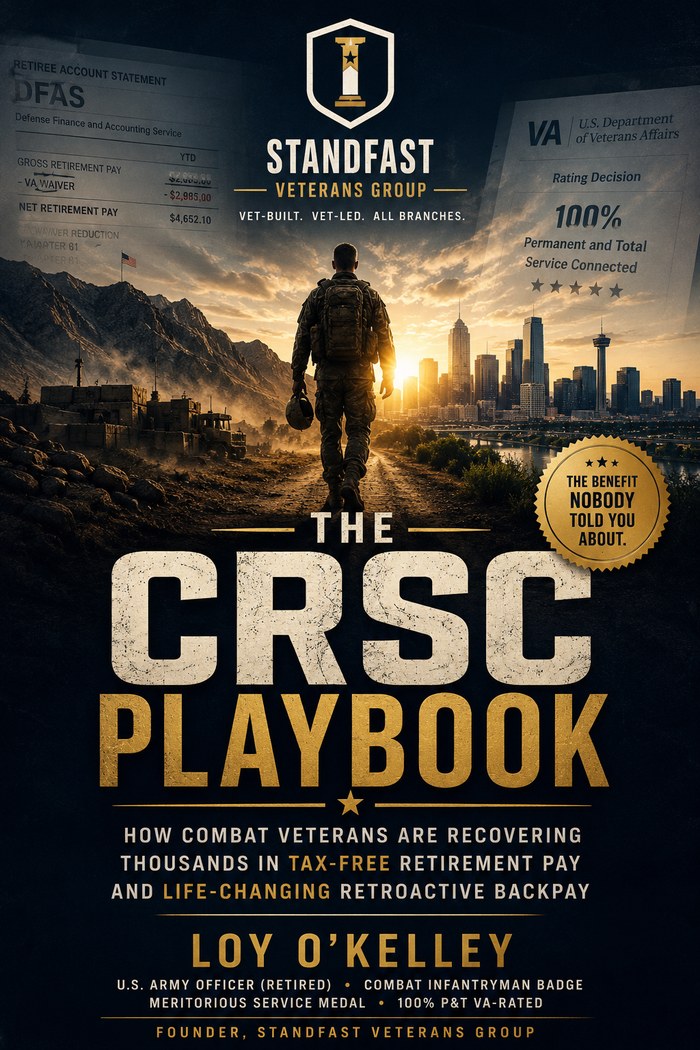
The CRSC Playbook
The founder's step-by-step guide to Combat-Related Special Compensation, built from real packets: eligibility self-checks, the four combat-related categories, the item 14.k narrative templates, and the post-Soto backpay rules.
Common questions.
Get your free 15-minute CRSC review.
Rates increase October 1. Book your free consult by September 30 and today's rate is locked, even if your packet starts later.
Five fields. We reply within one business day (Mon–Fri 0900–1700 CT) with a call slot, and we get the rest of the detail on the call. No cost, no obligation. Prefer to pick your own time? The booking calendar is just below.
PHONE:
(830) 266-7140
Fastest answer: text the word CRSC to (830) 266-7140 and we'll text you back.
EMAIL:
intake@standfastvg.com
HOURS:
Mon–Fri 0900–1700 CT • Closed federal holidays
Rather pick your own time? Book a slot directly.
Same free 15-minute consult — you just choose the time yourself and get an instant calendar invite.