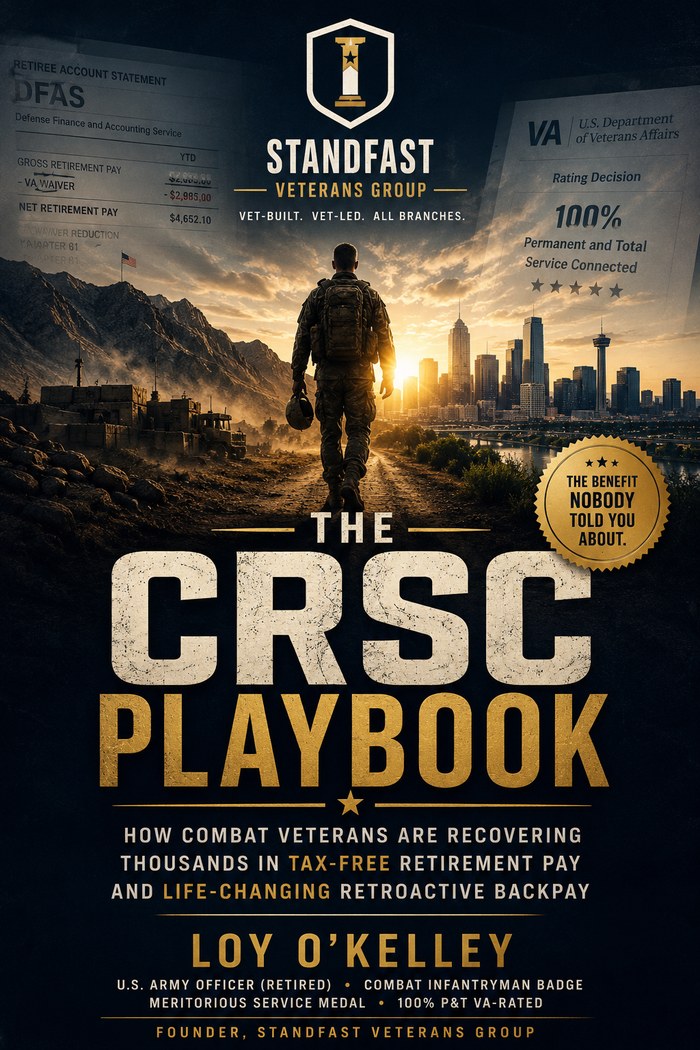
Why this book exists
When Loy O'Kelley sat down to file his own Combat-Related Special Compensation claim, he found what most retirees find: a benefit worth tens of thousands of dollars, guarded by a process nobody explains. The forms are short. The instructions are vague. And the part that actually decides your claim — proving each condition is combat-related — is barely mentioned anywhere official.
So he did it the hard way. He read the statute, mapped every condition, and built a 277-page packet that proved each causation chain on paper. Then he wrote The CRSC Playbook so the next retiree wouldn't have to start from zero. It's the same approach Standfast uses to build client packets today — set down step by step, in language a veteran can actually use.
The short version: CRSC isn't won on the form. It's won on the narrative — the part where you connect each rated condition to armed conflict, hazardous duty, training that simulated war, or an instrument of war. The Playbook is built around getting that part right.
What The CRSC Playbook actually teaches you
This isn't a pamphlet that tells you CRSC exists and wishes you luck. It walks the whole claim, start to finish:
- How the VA Waiver works — and what it's quietly costing you. The book opens with the math most retirees never see: why your deposit barely moved when your rating went up, and how CRSC gives those dollars back tax-free.
- The four combat-related categories, in plain English. Armed conflict, hazardous duty, conditions simulating war, and instrumentality of war — with real examples of what qualifies under each, and why you don't need a Purple Heart or a deployment.
- How to write Block 13 (now item 14.k) narratives that a board can read. The heart of the book. Templates and worked examples for the combat-causation statements that decide your claim — the exact place most first-time packets fall apart.
- CRSC vs. CRDP, and how to pick the right lane. When CRSC pays more, when CRDP does, and why the tax-free status and backpay often tip it toward CRSC.
- The post-Soto backpay rules. How the 2025 Supreme Court decision and the 14 May 2026 DoD guidance changed what retroactive pay you can claim — including per-condition effective dates and how to recover income tax you already paid on CRDP.
- Filing mechanics — new in the Third Edition. Wet-ink signatures, the documents the board actually requires, the 13 MB rule, the 12e supplement rule, and a pre-file quality check to score your packet before it goes out. It also covers assembly: what goes in the packet, in what order, where it gets filed for your branch, and what to expect after you hit send.
The worksheets in the back
The Playbook closes with the fill-in tools Standfast uses internally: the Eligibility Self-Check, the Evidence Inventory Worksheet, and the Soto Retroactive Estimator — plus the decision tree and calculators that turn the concepts into your numbers.
Want to try them before you buy? The same core worksheets and calculators are free at standfastvg.com/quickstart.
Who the book is for
- The do-it-yourselfer. If you've got the time and the patience and you want to file your own packet, this is the manual. It's the difference between guessing and knowing what the board needs to see.
- Service members heading for the door. If you're approaching retirement and your final separation exams, the Playbook shows you what to document now so the evidence exists when you need it later. The cheapest claim to win is the one you set up before you ever leave.
- Spouses and family doing the research. Plenty of CRSC homework gets done by a spouse first. The book is written to be readable by someone who didn't serve but is helping someone who did.
- Anyone who wants to understand their claim before hiring help. Read it first and your free consult goes faster — you'll already speak the language.
How the book helps you avoid the denial traps
Most CRSC denials aren't because the retiree didn't qualify. They're because the packet didn't prove the connection in the way the board is trained to read. A condition gets listed without a causation chain. A category is claimed without an incident behind it. The evidence is in the file but never tied to the narrative. The Playbook is organized around those exact failure points — it teaches you to write the connection so plainly that the determination is easy to make. We break the most common ones down in Where Most CRSC Packets Die: the four-category determination.
Book or done-for-you: which path is yours?
The book and our packet service are two doors into the same house. The Playbook is for retirees who want to file it themselves and have the time to do it carefully. Our full packet preparation is for retirees who'd rather have it built for them — same method, done by the team, flat fee, never a percentage of your backpay. Either way, you end up with a packet that proves what it needs to prove.
Not sure which lane you're in? Take the free 30-second eligibility quiz first — it'll tell you whether CRSC likely applies to you before you spend a dollar on anything.
A note on what the book is — and isn't. The CRSC Playbook is an educational guide. It is not legal, financial, or tax advice, and it cannot guarantee approval — CRSC outcomes are determined solely by your service branch's CRSC board. What it can do is make sure your packet gives that board every reason to say yes.
Frequently asked questions
Is the book worth it if I might hire Standfast anyway?
Yes. Many readers use it to understand their own claim before they ever call, which makes the free consult faster and more useful. And if you decide to file yourself, you'll have the full method in hand.
Does it cover my branch?
Yes. CRSC is federal (10 U.S.C. § 1413a) and the DD Form 2860 is the same across all six branches. The categories, narrative work, and evidence rules apply whether you're Army, Marine Corps, Navy, Air Force, Space Force, or Coast Guard. The book notes where the submission address differs by branch.
Will it help me if I'm still in the military?
Especially then. The book shows you what to document before your final exams and separation, so the evidence exists when you file later. Setting it up early is the single biggest favor you can do your future claim.
Where can I get The CRSC Playbook?
It's available now on Amazon for $9.99 on Kindle. The core worksheets and calculators are also free at standfastvg.com/quickstart if you want to start there.
The Standfast Bookshelf
Standfast's founder built his own 277-page claim packet before he ever helped another veteran with theirs. These books are that method: plain language, no gimmicks, no guarantees, just the evidence-first process the system rewards.
The CRSC Playbook
The step-by-step guide to Combat-Related Special Compensation: eligibility self-checks, the four combat-related categories, the Block 13 (now item 14.k) narrative templates, and the post-Soto backpay rules, start to finish.
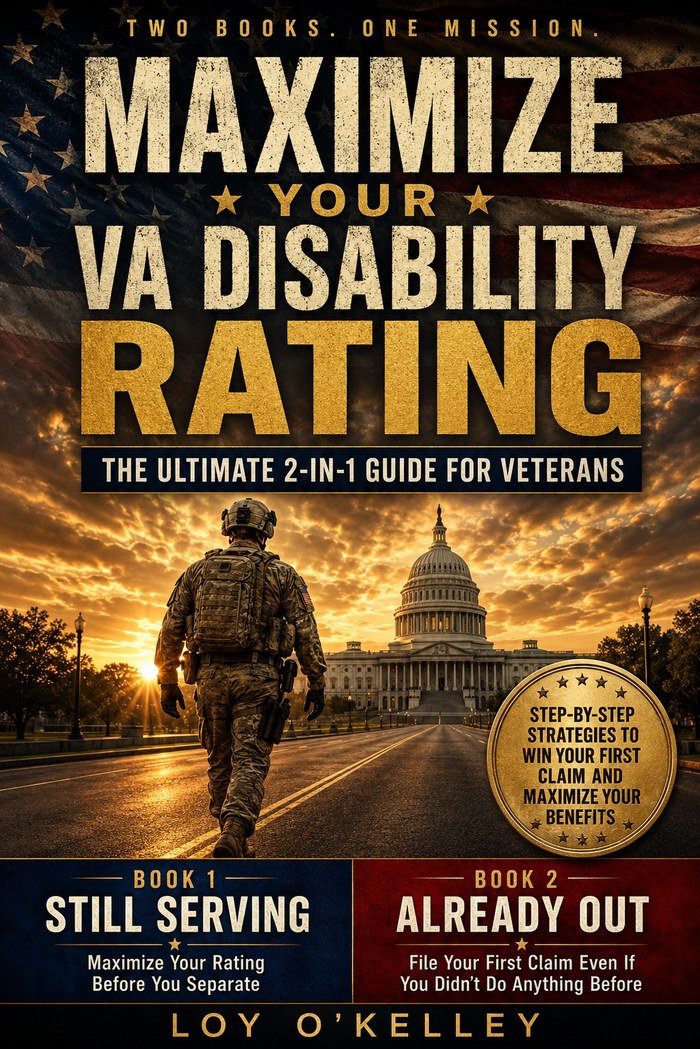
Maximize Your VA Disability Rating
The ultimate 2-in-1 guide: Book 1 for service members still in uniform (build your rating before you separate), Book 2 for veterans already out filing their first claim, even decades later. Rating guides, C&P playbook, appeals, and word-for-word templates.
Want to start free first? Work through the free tools and worksheets or take the 30-second eligibility quiz. Already read the Playbook? Playbook readers start here.